Selling random trinkets isn't a business model, and renting out cheap machine hours rarely fixes that. A printer becomes a commercial tool when a seller defines the buyer, the outcome and the price, then delivers a part that meets an agreed brief.
The practical answer to how to make money with 3D printers is to sell a narrowly specified result: a prototype enclosure, a non-critical replacement bracket, a repeatable hobby accessory or an original downloadable design. For UK sellers, the jobs worth accepting also depend on tax, returns, design permissions and product risk, not just whether the machine can print them.
Table of Contents
- Which 3D Printing Routes Actually Pay
- How to Price One Print Job
- How to Find Customers for Custom Parts
- How to Keep One Printer Productive
- Check Tax Refunds and Safety Before You Sell
- Publish One Clear Offer and Take the First Order
Which 3D Printing Routes Actually Pay
A quoted outcome is a stronger offer than access to a printer. An engineering buyer needs a prototype that fits its mating component. An architect needs a model suitable for a presentation. Neither benefits from buying machine hours without a definition of the finished result.
IBISWorld estimates that the UK 3D Printing and Rapid Prototyping Services industry reached £753.2 million in 2026, with a 6.5% compound annual growth rate between 2021 and 2026. Demand includes prototypes, replacement components, design iterations, low-volume production and customised parts. That's an industry total, not a personal profit forecast.
Routes to revenue from one desktop printer
| Route | What you sell | Best suited to | Margin killer | How price is set |
|---|---|---|---|---|
| Defined print service | Prototype, replacement part or small run | Engineering and product design buyers | Labour, failed prints and unclear scope | Quoted job with lead time and revision limit |
| Small-batch FDM parts | Repeat or one-off physical items | Organisers, décor and hobby parts | Copying a per-gram price | Small-part price plus handling and minimum-order charges |
| Design plus print | CAD changes and the printed part | Buyers without a print-ready file | Unlimited revisions | Print price plus a design fee |
| Original digital files | Downloadable models owned or commercially licensed by the seller | Designers with commercial rights | Selling a file without resale permission | Download price, with design and support costs but no filament |
| Short print-farm catalogue | A few repeatable designs suitable for low-intervention production | Sellers with a reliable FDM printer | Idle time and failed jobs | Markup on full cost, not filament alone |
Each route needs a different agreement before payment. A defined service needs intended use, dimensions and acceptance criteria. Catalogue goods need an accurate description, finish photographs and delivery terms. Design-plus-print work needs an approval stage, while digital files need a file-format description and a clear buyer licence.
For a short production catalogue, the seller must also decide which colours, materials and sizes remain available. Every extra option creates another combination to validate, stock and explain.
Choose the buyer before the object
The UK Additive Manufacturing Landscape report identifies prototyping and customisation as important applications while noting high costs and low production rates as limitations of conventional additive manufacturing. That makes specialist, low-volume work a more defensible starting point than mass-producing generic objects.
Engineering, product design, education, architecture, theatre and hobby manufacturing offer different problems to solve. A theatre workshop may value an unfinished prop component; a product designer may need an enclosure that can be revised after a fit check. Those aren't interchangeable offers.
For idea generation, Sculpty's guide to printable projects provides a useful starting point for identifying printable categories. Ideas still need filtering through buyer demand, finishing effort and permissions; a printable object isn't automatically a saleable product.
The same distinction helps when assessing the best product to sell: the useful question is which buyer has a problem the seller can resolve reliably.
The strongest starting catalogue may be a single service with firm boundaries, rather than a shelf full of unrelated objects.
A seller should choose a route and a buyer before considering another machine.
How to Price One Print Job
Price the fully loaded job, never filament alone. A copied per-gram rate says nothing about the seller's preparation time, finishing standard, failed attempts or customer support.
The worked example below separates inexpensive inputs from work that must be measured. The filament figure uses an illustrative spool cost within the stated range, rather than suggesting that every spool produces the same result.
Fully loaded cost of a 60 g PLA part
| Cost line | Worked figure | How to use it |
|---|---|---|
| PLA filament | About £1.02 for 60 g using a spool price within the roughly £15–£25 per kg business-price range in the UK printing cost guide | Use sliced weight, including supports, and the actual spool price |
| Electricity | About £0.12 for four hours at 120 W and £0.25/kWh | Include power without letting it determine the selling price |
| Failure and waste reserve | A starting allowance of 10% of direct production cost | Include scrap before adding labour, then replace the estimate with measured experience |
| Labour and messages | Measured file-checking, slicing, finishing, packing and communication time | This can outweigh the material cost |
| Packaging and postage | Actual pack and delivery cost | Keep delivery identifiable |
| Setup or minimum charge | The seller's floor for accepting small jobs | Apply when preparation and communication would otherwise erase the return |
The electricity and reserve figures are costing assumptions, not universal tariffs or failure rates. A commercial quote also needs printer depreciation, maintenance, software and applicable transaction costs. Tax needs separate consideration when forecasting take-home earnings; it isn't another filament surcharge.
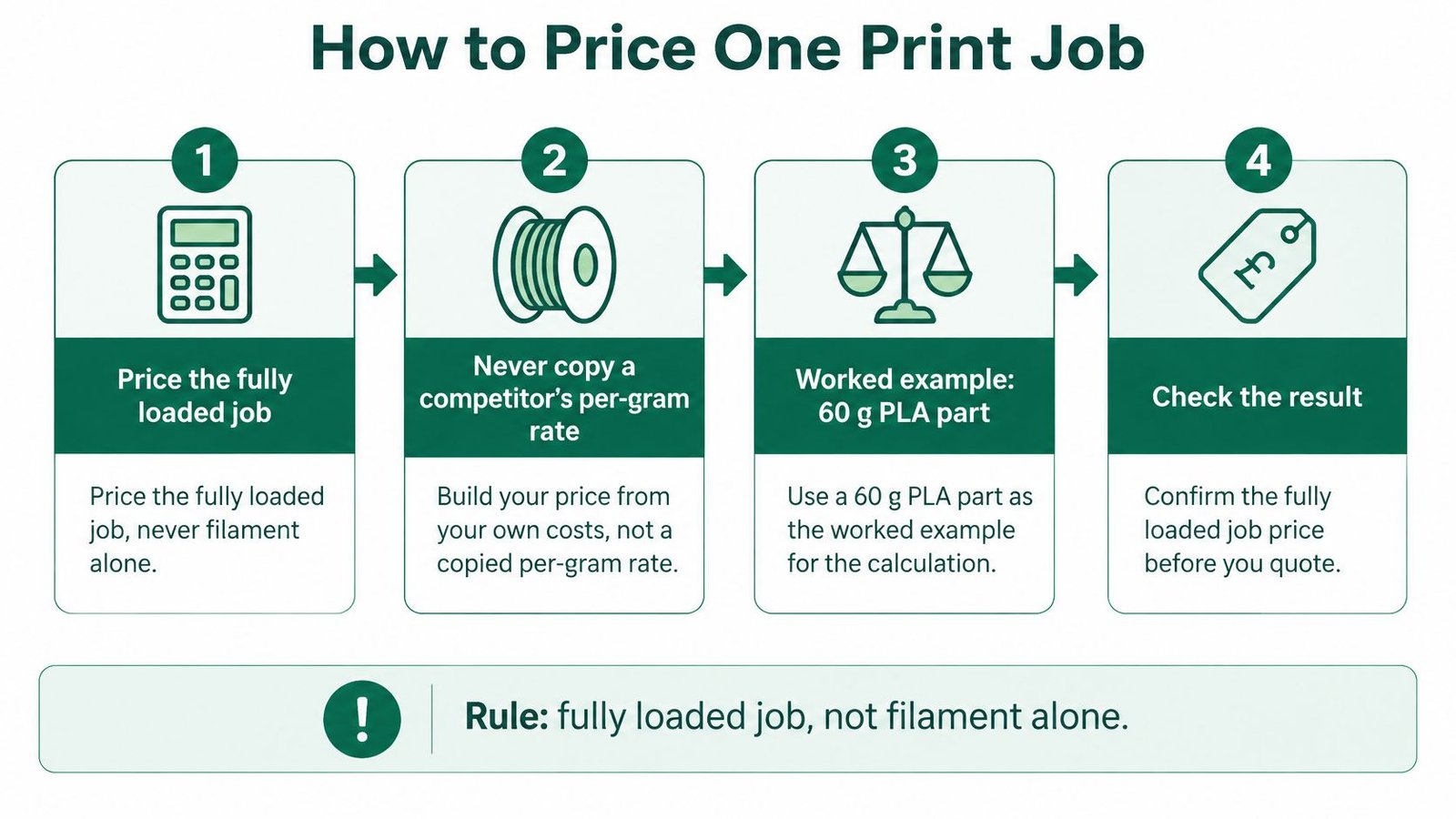
A quoting routine that protects the evening
- Confirm the brief. Establish the file, material, intended use and deadline. A damaged sample or photograph isn't equivalent to a dimensioned CAD model.
- Slice the actual job. Record grams, machine hours and supports in PrusaSlicer, OrcaSlicer or another suitable slicer. Orient for strength and sensible support removal, not merely the shortest print estimate.
- Build the production cost. Add filament, electricity, consumables and the waste reserve. Purge material and supports belong in the calculation.
- Add labour at an acceptable rate. Include file inspection, preparation, dimensional checks, post-processing, packing and messages. Waiting for a print isn't the same as actively finishing it, so record those separately.
- Include packaging and postage. A fragile model may require a protective insert or a larger box than its dimensions suggest.
- Apply the minimum charge. A tiny part still requires order handling. A setup fee prevents apparently profitable work from consuming unpaid evenings.
- Present bounded choices. Offer a standard print, an upgraded material or finish, and a design-plus-print package. Each needs its own inclusions and revision boundary.
For jobs that might suit another manufacturing method, sellers can compare 3D printing production costs through American Additive Manufacturing's guide. The useful comparison is the cost of an accepted finished part, not the material entering each process.
A quote should separate assumptions from commitments. If a customer supplies an untested model, a paid fit-check stage can prevent the seller from promising a finished production run before checking the geometry.
Finally, an order log should record quotation acceptance, revision requests, dispatch performance, refunds and contribution after variable costs. An attractive selling price means little unless the completed job pays for the work behind it.
How to Find Customers for Custom Parts
A narrow offer makes outreach easier to understand. Prototype enclosures, obsolete non-critical brackets, architectural components and tabletop accessories each suggest different buyers, sample photographs and questions.
An illustrative offer could read: PLA prototype enclosure printed from a supplied STEP file, including a bounded fit adjustment, with dispatch scheduled after file approval. The published version must specify the revision allowance and the actual turnaround the seller can maintain.

Outreach before a storefront
- Make three finished samples. Treat this as a practical launch exercise, not a demand forecast. Photographs should show a ruler or callipers, visible layer lines, support-contact areas and the supplied finish.
- List ten plausible local buyers. Product designers, small engineering workshops, theatre departments, education departments, repair businesses and established hobby sellers are starting points. The list should contain buyers for the selected outcome, not merely nearby businesses.
- Send a specific sample-job proposal. The message should identify the part offered, acceptable files, material boundary and proposed lead time. A generic announcement that printing services are available gives the recipient too much work.
- Ask about repeat requirements. After an accepted job, establish which component, size or revision the buyer might need again. That answer is more useful than a vague request for feedback.
- Record the commercial response. Keep the contact, requested outcome, quoted scope, accepted price and repeat-order status together.
These are suggested outreach targets rather than claimed conversion benchmarks. The purpose is to learn whether the niche contains buyers with a current requirement.
Start the conversation with use, tolerance and deadline
A workshop ordering a jig needs confidence that the part will locate correctly. A theatre department may care more about appearance at viewing distance and whether paint will adhere. The first conversation should establish those requirements before discussing machine specifications.
An illustrative outreach note might explain that a seller produces non-critical prototype housings from supplied CAD files, then ask whether the recipient has a current fit-check requirement. A relevant sample photograph and clear file requirements give the buyer something concrete to assess.
A useful reply contains a part, a file or a requirement. Likes and compliments don't establish demand.
A full website and a sprawling catalogue can wait. Practical advice on starting an online business with no money is most relevant when it helps keep early effort focused on demand rather than presentation.
A clear offer page can be shared through direct messages, relevant profiles and existing sites once scope and delivery are settled. If the initial targeted outreach produces no usable brief, the seller should narrow the buyer or problem before cutting the price.
How to Keep One Printer Productive
A printer earns its keep by delivering a repeatable result for a defined job, not by running constantly. Before adding another machine or accepting more orders, use ten consecutive acceptable production prints as a practical validation gate. The Hobby Supermarket UK costing guidance can inform power and markup assumptions, but this threshold is a seller's own operating rule. It checks whether the process consistently produces work that meets the offer.
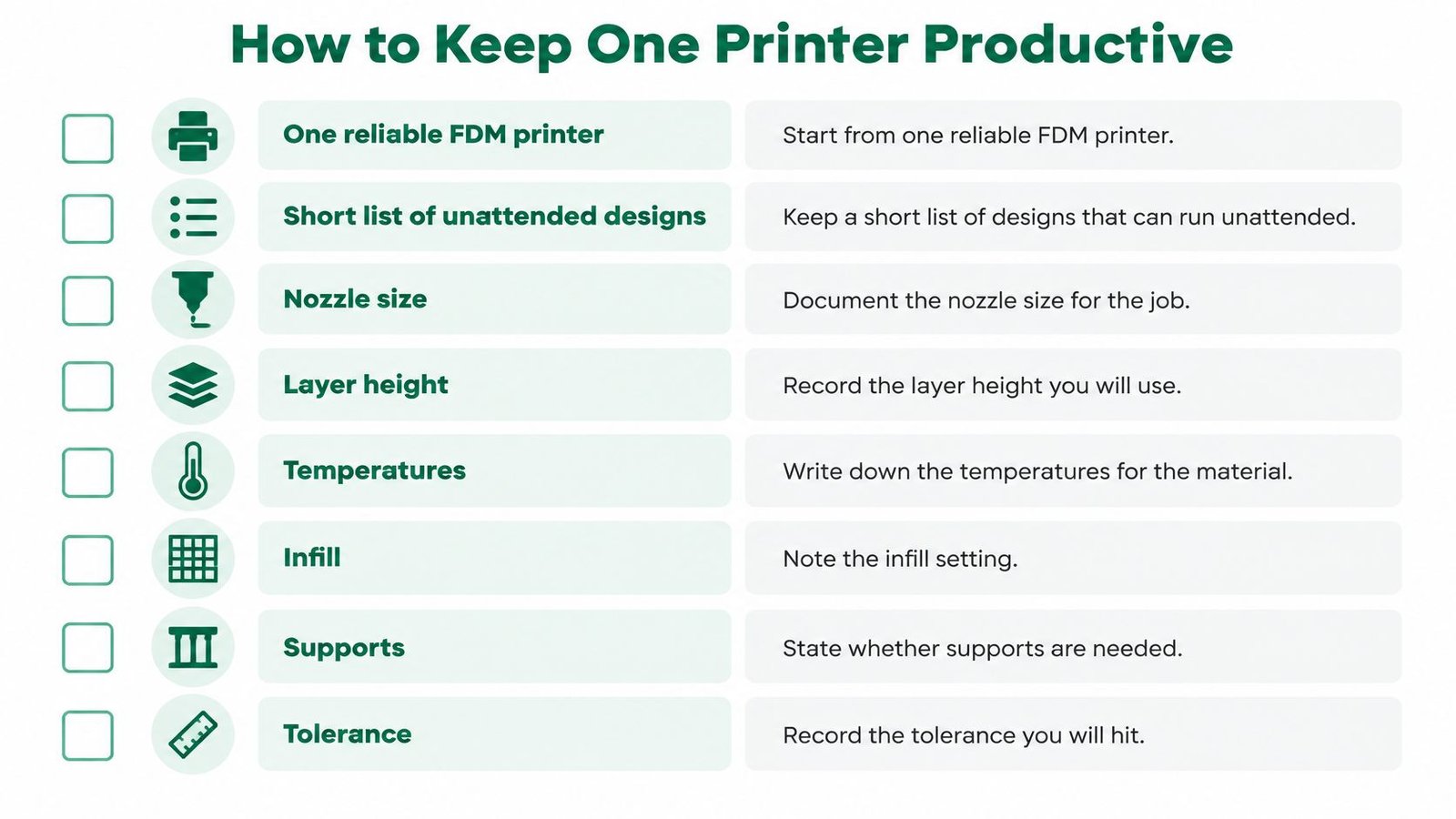
A reliable FDM printer and a short catalogue make repeatability easier to assess. Choose work suited to low-intervention runs, while following the manufacturer's safety instructions and maintaining a suitable workspace.
Write a production specification
A saved STL file is not a production record. Without documented settings and acceptance criteria, a small change in material, orientation or support can alter the result.
- Machine and material: Record the printer, nozzle size, filament type and drying requirements.
- Slicer settings: Save layer height, temperatures, infill, wall settings, orientation and supports.
- Dimensional checks: Identify critical features and the tolerance promised to the buyer.
- Cosmetic acceptance: Define acceptable seams, layer lines and support marks. Photographs can make the standard clearer.
- Finishing method: Record deburring, assembly and any surface treatment.
- Traceability: Link the file revision and inspection result to the order.
Capacity isn't the same as calendar time
Estimate output from available machine hours × realistic utilisation, then allow for failed prints, maintenance, queue changes and finishing. Count each source of downtime once. A machine can be free while the seller is still removing supports, checking parts or packing orders. Another printer adds no dispatch capacity if unfinished work is already waiting.
The cited UK calculator gives desktop-printer consumption of around 120–150 W and electricity costs near £0.04–£0.05 per operating hour at roughly £0.25–£0.30/kWh. It describes hobbyist markups of 50–100% and professional-service markups of 100–300% on full cost. Treat these as illustrative inputs, not net profit margins or proof that a job will sell.
Labour, failed prints, idle time, design permissions, packaging, customer acquisition and support can outweigh filament cost. Complex geometry and material changes may affect reliability, so use the production log to judge a particular job rather than relying on a headline markup. Keep spare nozzles and a small maintenance kit available, and leave schedule space for reprints. Quoting every available hour leaves no room to recover from a fault.
Operating threshold: Pause a product if its measured contribution cannot support the seller's chosen hourly return, even when the filament markup looks attractive.
Base payback decisions on completed, paid orders and realistic operating costs. Revenue growth alone does not justify expansion if finishing time remains unpaid.
Check Tax Refunds and Safety Before You Sell
This is general UK information, not individual tax, legal or insurance advice. Sellers should check current HMRC and GOV.UK guidance against their circumstances, particularly when supplying businesses, selling abroad or offering products with specialist uses.
Tax and returns belong in the commercial plan
HMRC's trading-allowance guidance allows eligible individuals up to £1,000 of gross trading income in a tax year under the allowance, with Self Assessment registration generally required by 5 October following the relevant tax year when gross trading income exceeds that threshold. Gross receipts count before filament, postage or fees, so printed goods, design work and file sales must be considered together.
Using the allowance means actual business expenses can't also be deducted against that same income. A seller with substantial equipment and material costs should compare the available treatment rather than assuming the allowance is automatically preferable.
For distance sales, GOV.UK's returns guidance normally gives customers 14 days after receipt to notify cancellation, another 14 days to return goods, and requires the seller generally to refund within 14 days of receiving the return, including standard delivery. Customers normally needn't provide a reason; exceptions include certain personalised or custom-made goods.
Printing only after an order arrives doesn't justify assuming that every item is exempt. Faulty or misdescribed goods have separate remedies, potentially including a full refund, so production times, personalisation terms and fault-reporting arrangements need clear wording before payment.
Risk tiers for what you print and sell
| Tier | Examples | Before you sell |
|---|---|---|
| Decorative or organisational | Planters, desk organisers, non-functional décor | Record material and settings and state ordinary consumer terms |
| Functional, not safety-critical | Jigs, brackets and enclosures away from heat, mains electricity or structural loads | State intended use, tolerance and inspection method |
| Higher-duty consumer goods | Toys, children's items, food-contact pieces, electrical enclosures | Identify applicable requirements and obtain specialist advice before listing |
| Safety-critical or regulated | Appliance spares exposed to heat, pressure, movement or structural load | Don't market as a certified replacement without the necessary technical evidence and compliance assessment |
These tiers are a screening tool, not a legal classification or safety approval. Even apparently ordinary products need assessment for their actual use.
The UK government assessment of 3D-printed appliance spare parts identifies technical safety issues and potential responsibilities across the supply chain. Downloading a model or producing a small batch doesn't remove responsibility for the finished part.
Design permission is a separate check. The UK government's intellectual-property study explains that CAD files and printed objects may attract overlapping copyright and design protections. Sellers should retain original design records or an explicit commercial licence, including its resale limits; attribution alone isn't permission.
A practical UK online-selling checklist can help organise the trading setup, but it doesn't replace product-specific assessment. Where ownership, intended use or safety remains unclear, specialist UK advice and an appropriate insurance discussion are sensible before the job enters the catalogue.
Publish One Clear Offer and Take the First Order
The offer to publish this week should be the narrowest job the seller can quote, produce and inspect confidently. A non-critical prototype enclosure from a customer-supplied file is a clearer starting point than an unrestricted promise to print anything.
The scope should be honest enough that a buyer can understand both the result and its limitations without a long exchange of messages.
A publishable offer needs firm boundaries
- Title and outcome: Name the finished part or service, rather than the printer.
- Inclusions: State the material choice, quantity, finishing level and inspection provided.
- Buyer inputs: Specify the required file, dimensions and intended use.
- Approval and revisions: Define what can change and when additional work needs a new quote.
- Timing and acceptance: Give a realistic production window and describe an acceptable finished part.
- Exclusions: Rule out unsupported safety-critical uses and designs without the necessary permissions.
AmaJova can turn that defined job into an OfferLink without a website, allowing sellers to start selling in minutes once the scope is ready. A physical-product draft takes a price, currency, stock quantity and delivery time; for digital products, files or access are supplied through the buyer's order record.
Publish for the work that follows payment
The seller journey is Create, Share, Sell, Fulfil and Get paid. Payment isn't completion: messages, approvals and delivery should stay connected to the order so that a revision doesn't disappear into an unrelated email thread.
Sharing the offer with relevant buyers is more useful than delaying launch for a full shop build. If broader retail requirements later justify a storefront, 3228 Digital UK's guide to choosing a UK e-commerce platform provides a separate planning resource.
A practical first-month scorecard can aim for twenty tracked orders, treated as a working target rather than an earnings forecast. The meaningful tests are timely fulfilment, manageable revisions and a return above the seller's hourly floor, not ownership of another printer.
AmaJova offers a clear OfferLink with secure checkout for a defined print service, physical product or digital file. A seller ready to publish a properly scoped job can visit AmaJova, create the offer and share it with the buyers most likely to need that result.